Secure Peptide Shipping Logistics: A Methodological Framework for Protocol Integrity

The integrity of a professional recovery protocol isn't determined solely in the laboratory or the training facility; it's often decided within the precarious hours of transit where environmental variables threaten molecular stability. A single thermal excursion during secure peptide shipping logistics can render a meticulously designed methodology entirely obsolete, turning a strategic investment into a significant liability. You recognize that standard courier services frequently fail to provide the transparency and thermal consistency required for high-stakes research, leaving protocols vulnerable to degradation and logistical oversight.
This guide establishes a comprehensive framework for mastering the technical and logistical requirements necessary to maintain peptide stability throughout the professional supply chain. You'll gain a disciplined understanding of the risk-based frameworks defined in USP General Chapter <1079> and the necessity of digital data loggers that record temperatures at 30-minute intervals. We'll conclude by outlining a rigorous methodology for evaluating third-party logistics providers to ensure your protocols remain insulated from the systemic risks of the global cold chain, maintaining the precision your objectives demand.
Table of Contents
The Critical Role of Secure Peptide Shipping Logistics
Secure peptide shipping logistics is the rigorous application of environmental controls and procedural oversight to ensure the biochemical integrity of sensitive compounds. It functions as the intersection of a validated temperature-controlled supply chain and a transparent chain of custody. For the dedicated professional, logistics isn't a peripheral concern; it's the primary safeguard against protocol failure. When molecular structures are compromised during transit, the resulting data is corrupted, and the physiological objectives are jeopardized.
Failures in secure peptide shipping logistics represent the most significant threat to research and protocol integrity. While laboratory synthesis may be precise, the period between the point of origin and the final destination is fraught with variables. Standard courier services operate on a volume-based model that prioritizes speed over stability. This approach is insufficient for peptides, which are inherently fragile. Specialized medical-grade logistics prioritize the maintenance of molecular structures through constant monitoring and climate stabilization. Professionals who prioritize data-driven recovery outcomes understand that a compromised shipment is a failed protocol.
Defining Protocol Integrity in Logistics
Protocol integrity relies on the consistent maintenance of specific thermal and mechanical conditions. Shipping speed is a secondary metric; the primary metric is compound stability. Degradation occurs rapidly when peptides are exposed to temperatures outside their validated ranges, often occurring before visible changes to the product are apparent. This "Chain of Integrity" links the manufacturing environment directly to the professional advisor's oversight. Logistical variables, including thermal fluctuations and mechanical stress, directly influence the efficacy of any physiological recovery strategy. If the chain is broken, the protocol's foundation is lost.
The Shift from Transactional to Methodological Shipping
Standard e-commerce fulfillment focuses on the transaction, often using "discreet shipping" as a substitute for technical transparency. Technical logistical oversight replaces this superficial approach with data-driven methodology. Elite recovery protocols demand more than a package left on a doorstep; they require a system where every transit mile is accounted for and every environmental risk is mitigated. A professional advisory service provides this level of management, ensuring that the supply chain reflects the same precision as the recovery protocol itself. This transition ensures that the focus remains on excellence and accuracy rather than mere convenience.
Technical Requirements for Maintaining Peptide Stability
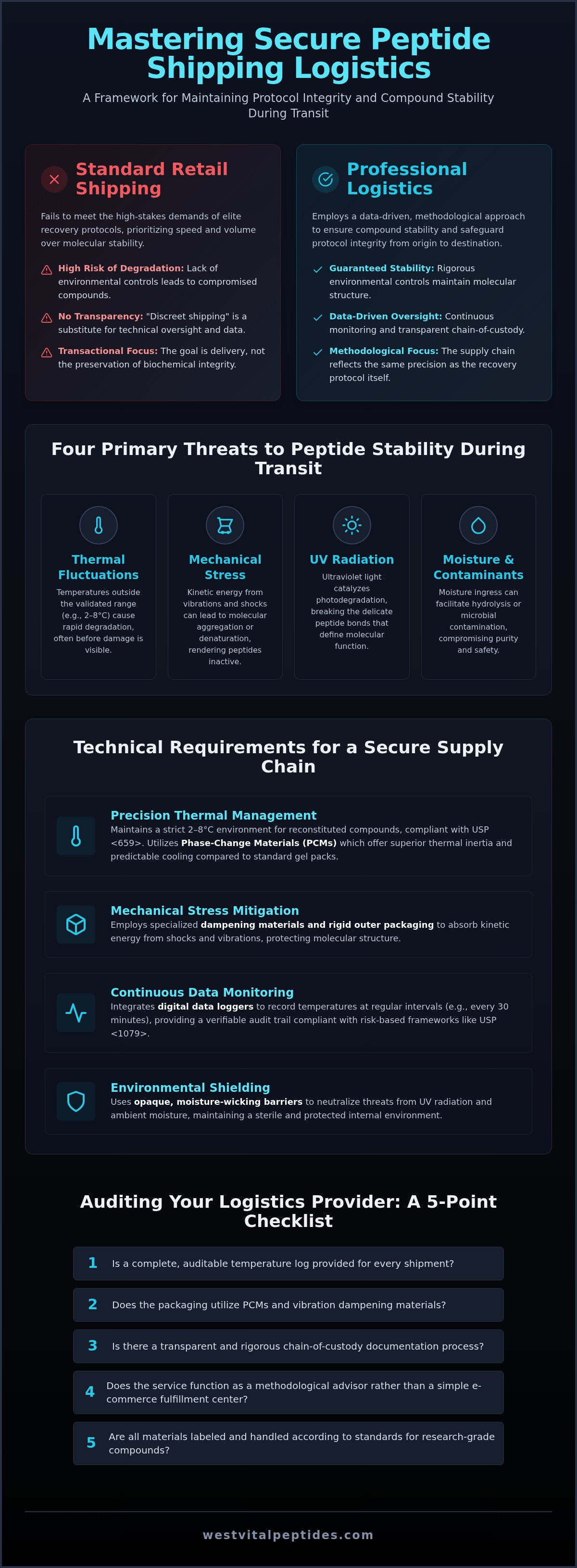
The structural integrity of a peptide sequence is exceptionally susceptible to mechanical agitation. Kinetic energy transferred through standard shipping vibrations can lead to molecular aggregation or denaturation, rendering the compound biologically inactive before it reaches its destination. Secure peptide shipping logistics must account for these mechanical stressors by utilizing specialized dampening materials and rigid outer packaging. High-stakes recovery protocols cannot afford the uncertainty of unmonitored transit where physical shocks go unrecorded.
Environmental variables such as ultraviolet light and ambient moisture pose additional risks to compound purity. Ultraviolet radiation catalyzes photodegradation, breaking the delicate peptide bonds that define the molecule's function. Simultaneously, moisture ingress within a package can facilitate microbial contamination or lead to the hydrolysis of the compound. Professional logistics utilize opaque, moisture-wicking barriers to neutralize these threats. Maintaining a sterile, light-protected environment is a non-negotiable standard for protocol integrity.
Thermal Management and Cold Chain Logistics
Precision recovery management relies on strict adherence to the temperature thresholds defined by USP General Chapter <659>. Reconstituted compounds require a maintained environment of 2–8°C, a range that standard gel packs often fail to sustain during transit delays. High-performance logistics utilize phase-change materials (PCM) which offer superior thermal inertia and more predictable cooling curves. These systems are validated using integrated data loggers that record environmental conditions at 30-minute intervals, ensuring full transparency. Integrating best practices for shipping biological specimens ensures that the cold chain remains uncompromised from the laboratory to the final point of use. Overnight transit is a technical requirement to minimize the window of potential thermal excursion. Professional oversight ensures these technical standards are met, providing a level of logistical assistance that standard retail channels cannot replicate.
The Role of Lyophilization in Logistical Resilience
Lyophilization, or freeze-drying, significantly enhances a peptide's resilience by removing the solvent through sublimation. This process creates a stable powder that is far less reactive to thermal fluctuations than liquid-state compounds. While liquid shipping is often cheaper, it introduces unacceptable risks for specialized wellness protocols due to the rapid degradation of peptide bonds in aqueous solutions. Lyophilization stability refers to the enhanced biochemical resistance of a peptide to thermal and mechanical degradation achieved through the removal of solvent via sublimation in a vacuum environment. This methodological approach to stabilization ensures that the compound retains its full potency throughout the logistical journey.
Evaluating Logistics Providers: Professional Advisory vs. Retail
Selecting a partner for secure peptide shipping logistics requires a transition from a consumer mindset to a methodological one. Most providers operate on a retail fulfillment model designed for high-volume, low-sensitivity goods. These third-party logistics (3PL) warehouses prioritize cost-efficiency and throughput over the technical nuances of molecular preservation. Red flags in these environments include a reliance on standard postal services, a lack of real-time environmental tracking, and the use of non-validated packaging. These oversights are not merely inconveniences; they are systemic failures that compromise the foundation of your recovery strategy. A disciplined approach recognizes that the lowest shipping cost often correlates with the highest risk of protocol failure.
Retail Fulfillment Limitations
Automated e-commerce "check-out" systems are inherently limited because they treat logistical variables as static options rather than dynamic risks. In high-volume facilities, individual package oversight is virtually nonexistent. If a thermal excursion occurs during a delay, there's no technical accountability to assess the impact on the compound's integrity. Standard retail models struggle with technical requirements because their infrastructure isn't built to manage the precision required for research-grade materials. This lack of professional accountability means the burden of risk falls entirely on the end user, who may receive a degraded product without any record of the failure. High-stakes recovery demands a level of transparency that automated retail systems cannot provide.
The Advantage of Logistical Assistance Services
Professional advisory services treat secure peptide shipping logistics as a critical extension of the protocol itself. Navigating the complexities of international transit and domestic regulatory shifts requires more than a shipping label; it demands active oversight and strategic planning. Effective peptide logistics management ensures that every variable is controlled through a disciplined partnership. This approach provides transparency throughout the supply chain, ensuring that the compounds used in recovery protocols meet the elite standards of accuracy and excellence. A professional advisor serves as a gatekeeper, validating the chain of custody and ensuring that the methodology remains intact from the point of origin to the final destination. This level of logistical assistance ensures that your focus remains on performance outcomes rather than supply chain troubleshooting.
Establishing a Secure Supply Chain for Wellness Protocols
Establishing a secure supply chain requires a proactive methodology that treats logistics as a core component of a professional wellness strategy. It's not enough to rely on a vendor's internal processes; a disciplined professional must audit the entire logistical pathway. This process begins with strategic scheduling to eliminate the variables associated with transit delays. Shipments are strictly dispatched on Mondays or Tuesdays. This protocol ensures that materials don't languish in non-climate-controlled sorting facilities over a weekend, where thermal monitoring is often absent. Strategic planning is the first line of defense in secure peptide shipping logistics.
Transparency is maintained through rigorous documentation and adherence to current regulatory standards. As of January 2026, the FDA's Final Guidance on Research-Grade Peptides is fully enforceable, requiring precise labeling and record-keeping for every shipment. Every package must include a Material Safety Data Sheet (MSDS) and verification of Institutional Review Board (IRB) oversight or equivalent institutional documentation. These records create a verifiable chain of custody, linking the compound directly to an approved research protocol. This data-driven approach ensures that the integrity of the compound is documented from the point of origin to the final destination.
Logistical Auditing for Professionals
A professional audit of the logistical pathway involves three critical checkpoints. First, you must verify that laboratory-grade packaging standards, such as phase-change materials and vacuum-sealed barriers, are utilized. Second, an analysis of the transit route's thermal exposure is necessary to ensure the mean kinetic temperature remains at or below 8°C, as defined by USP General Chapter <659>. Finally, you must confirm that the delivery protocols at the destination are secure. This includes ensuring that the receiving entity is prepared to transition the materials immediately to a controlled environment. If you require assistance in establishing these auditing standards, West Vital Peptides provides specialized logistical assistance for high-stakes protocols.
Risk Mitigation and Contingency Planning
Effective risk mitigation relies on redundant systems and non-negotiable security standards. Signature requirements are a mandatory protocol; they ensure that sensitive compounds are never left unattended in unsecured environments. Redundant tracking systems, utilizing both carrier data and independent environmental sensors, provide a continuous stream of information regarding the shipment's status. Contingency planning involves having established procedures for handling temperature excursions or transit delays. If a data logger indicates a breach of the 2–8°C threshold for more than 24 hours, the protocol must mandate a formal assessment of the compound's stability. A disciplined supply chain leaves nothing to chance, prioritizing the integrity of the recovery process above all else.
Methodological Logistics Support: The West Vital Peptides Approach
West Vital Peptides operates as a specialized partner for those who recognize that a recovery protocol is only as strong as its weakest logistical link. We provide more than mere oversight; we offer a rigorous methodology that ensures every variable in the supply chain aligns with the physiological requirements of the compound. This approach moves beyond the superficial guarantees of retail vendors, prioritizing the integrity of the process over the convenience of a sale. Secure peptide shipping logistics is integrated into the core of our advisory model, ensuring that the transition from laboratory to application is documented and controlled. We don't view logistics as a warehouse function, but as a critical component of institutional reliability.
Our commitment to transparency and scientific authority defines every protocol we manage. By removing the e-commerce checkout model, we eliminate the transactional risks that often lead to protocol failure. This separation ensures that our focus remains entirely on the accuracy and excellence of the logistical pathway. Professionals who value data and methodology over trends find a serious partner in our advisory services. We demand a high level of dedication to protocol from our clients, mirroring the precision we apply to their logistical needs. This disciplined environment is essential for maintaining the high-stakes outcomes required in elite physical performance.
Expert Guidance in Logistics Management
Coach West integrates logistical mastery into precision recovery management to eliminate the systemic uncertainties inherent in standard transit. Our data-driven worldview ensures that every decision, from packaging selection to carrier routing, is based on empirical stability requirements. Specialized advisory services eliminate the guesswork that plagues high-volume supply chains. We maintain a stoic commitment to accuracy, ensuring that the compounds used in your protocol are exactly as the laboratory intended. Elite performance requires an uncompromising approach to these details, where even a minor thermal excursion is treated as a breach of protocol integrity. Guesswork is replaced by a disciplined framework that accounts for mechanical stress, UV exposure, and thermal inertia.
Engaging with Professional Logistical Assistance
Transitioning from transactional purchases to a methodological advisory model begins with a formal professional inquiry. When you engage with West Vital Peptides, you should expect a logistical deep dive that evaluates your specific recovery needs and current supply chain vulnerabilities. This process establishes a validated pathway for all future materials, ensuring that every shipment meets our institutional standards. We don't offer a simplified e-commerce experience because high-stakes recovery demands a more sophisticated level of engagement. Our role is that of a high-level consultant who values the "how" and the "why" behind every logistical action. Reach out to initiate a strategic consultation and secure the integrity of your professional recovery protocols through expert logistical assistance.
Advancing Protocol Precision through Logistical Mastery
The maintenance of molecular integrity throughout the supply chain is a fundamental requirement for any serious recovery strategy. You've seen that standard retail fulfillment models often lack the technical rigor necessary to prevent compound degradation during transit. True protocol integrity relies on a methodological approach that prioritizes thermal stability, mechanical dampening, and a transparent chain of custody. By moving beyond transactional e-commerce, you ensure that your research materials are protected by institutional standards rather than warehouse convenience. Every variable must be controlled to maintain the precision your goals demand.
West Vital Peptides provides expert logistical oversight led by Coach West, emphasizing a methodology-first approach to recovery integrity. This disciplined framework eliminates the variables that compromise results, allowing you to focus on elite performance outcomes. If you're ready to transition from standard shipping to professional advisory, we invite you to inquire regarding professional logistical assistance for your wellness protocol. Mastering secure peptide shipping logistics is the final step in securing your data and your progress. Your commitment to excellence deserves a supply chain that mirrors your own dedication. We're here to guide you through every step of this critical process.
Frequently Asked Questions
What are the primary risks of standard shipping for peptides?
Standard shipping poses risks of thermal excursions and denaturation due to mechanical vibration. Standard couriers lack the environmental monitoring required for secure peptide shipping logistics, often leaving packages in non-climate-controlled facilities. These variables compromise the molecular structure, rendering the compound inactive. Without specialized handling, the "Chain of Integrity" is broken, leading to protocol failure and wasted resources for the professional researcher.
How does temperature affect the stability of research compounds during transit?
Temperature fluctuations catalyze the breakdown of peptide bonds, particularly in aqueous solutions. Research compounds must often remain within a "Controlled Cold Temperature" range of 2–8°C to maintain biological potency. Exposure to ambient heat during transit induces rapid degradation that is not always visible to the eye. Utilizing validated cold chain protocols ensures that the compound's mean kinetic temperature remains within specified limits, preserving its structural integrity.
Why does West Vital Peptides emphasize logistics over retail sales?
West Vital Peptides prioritizes logistical oversight because retail e-commerce models lack the technical accountability required for elite recovery protocols. Standard "checkout" systems treat shipping as a transaction rather than a variable that impacts physiological data. By focusing on advisory and logistical assistance, we ensure that every transit mile is managed with precision. This methodological approach filters out the risks inherent in high-volume, low-transparency retail fulfillment operations.
Can I track the chain of custody for my logistical assistance request?
Full transparency is maintained through integrated data loggers and rigorous documentation of every transit milestone. Our framework for secure peptide shipping logistics includes a verifiable chain of custody that tracks the compound from the laboratory to the final destination. This process ensures that any environmental excursion is recorded, allowing for a data-driven assessment of compound stability. We provide the documentation necessary to confirm that protocol integrity remained intact throughout the journey.
What is the difference between lyophilized and liquid shipping stability?
Lyophilized peptides are freeze-dried powders that exhibit significantly higher thermal resilience than liquid-state compounds. The removal of solvent through sublimation creates a stable matrix that resists degradation from ambient heat and mechanical agitation. Reconstituted peptides are far more fragile and require strict cold chain management to prevent hydrolysis. While lyophilized compounds are more robust, they still require professional oversight to ensure they are not exposed to extreme environmental stressors.
How do specialized carriers ensure thermal integrity for 48+ hours?
Specialized carriers utilize phase-change materials (PCM) and vacuum-insulated panels to maintain consistent internal environments for extended periods. Unlike standard gel packs, PCM offers predictable cooling curves and higher thermal inertia, neutralizing external heat spikes. These systems are validated to sustain the required 2–8°C threshold for 48 hours or longer, even during transit delays. This level of climate stabilization is a technical requirement for professionals who cannot leave protocol outcomes to chance.
What documentation is provided to verify secure shipping logistics?
Every shipment is accompanied by a Material Safety Data Sheet (MSDS) and documentation verifying institutional oversight, such as IRB credentials. In accordance with the 2026 FDA guidance, we provide labeling and records that link each compound to a specific research protocol. Additionally, digital data logs are available to verify that thermal thresholds were maintained. These records provide a transparent audit trail, ensuring that the supply chain meets the highest standards of professional accountability.


Comments