Methodological Peptide Handling Procedures: A Professional Checklist for Protocol Integrity

The difference between a successful recovery protocol and a total loss of physiological utility often comes down to a single degree of temperature variance or a moment of logistical negligence. You understand that while the scientific theory of peptide application is well-documented, the practical reality of maintaining chemical integrity is where many systems fail. There's a persistent anxiety surrounding the risk of temperature-sensitive degradation and the confusion that often accompanies complex reconstitution techniques. These variables aren't just minor inconveniences; they're direct threats to the integrity of your data and the success of your recovery objectives. Implementing rigorous peptide handling procedures is the only way to mitigate these risks and maintain a standard of excellence that mirrors the intensity of elite physical performance.
You'll master the technical requirements for maintaining peptide stability through disciplined handling and logistical precision. This article provides a structured checklist for environmental control and a verified methodology for maintaining oversight during transit. We'll examine the technical oversight necessary for successful recovery protocols, moving from high-level conceptualization to practical application. By the end of this guide, you'll have the confidence to manage every logistical detail with the same precision you apply to your physiological goals.
Table of Contents
The Scientific Foundations of Peptide Handling Procedures
Peptide handling procedures represent the disciplined management of environmental variables designed to prevent chemical degradation and preserve the structural integrity of the compound. In the Coach West philosophy, success is not merely the result of the protocol itself; it's the product of precision in both the "how" and "why" of logistical management. Professional oversight ensures that every step of the process, from initial receipt to final application, is governed by data rather than guesswork. Precision is the baseline. Without a rigorous methodological framework, the biological integrity of the sample is compromised before it ever reaches the final stage of a recovery protocol.
The Vulnerability of Peptide Bonds
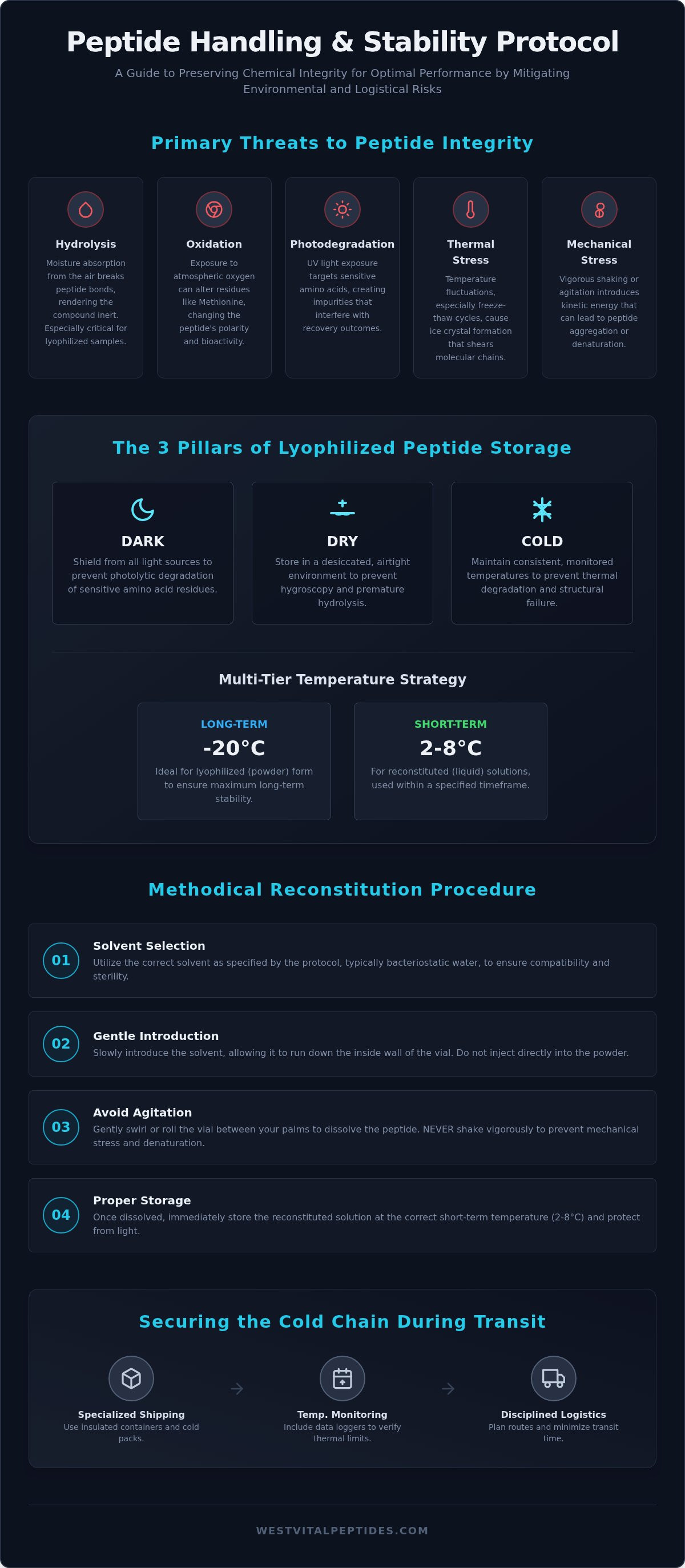
The chemical nature of the peptide bond makes it inherently sensitive to thermal energy, as even minor fluctuations can initiate a cascade of structural failure. Understanding the Scientific Foundations of Peptides is essential for recognizing how these chains of amino acids respond to external stimuli. Lyophilized samples are particularly susceptible to hygroscopy, where moisture absorption from the air triggers premature hydrolysis. This process breaks the covalent bonds between amino acids, effectively rendering the peptide inert. Deamidation serves as a primary risk factor for peptides containing Asparagine or Glutamine residues, leading to the formation of isoaspartate and a subsequent loss of biological function. These chemical shifts aren't always visible to the naked eye, yet they dictate the ultimate success or failure of your efforts.
Impact of Environmental Stressors on Stability
Biological integrity depends entirely on maintaining the precise molecular structure during storage and transit. UV light exposure facilitates photolytic degradation, specifically targeting sensitive amino acid residues like tryptophan or tyrosine. This reaction alters the chemical identity of the peptide, creating impurities that can interfere with the intended recovery outcome. Oxidation represents another significant threat, particularly for residues like methionine and cysteine. Exposure to atmospheric oxygen can lead to the formation of sulfoxides, which fundamentally changes the peptide's polarity and biological activity. Preventing this requires airtight sealing and a methodological approach to environmental control.
Temperature consistency is equally vital to avoid destructive freeze-thaw cycles. When a solution repeatedly freezes and thaws, the resulting ice crystal formation creates mechanical stress that shears the delicate molecular chains. Mechanical agitation, such as vigorous shaking during reconstitution, introduces kinetic energy that can lead to aggregation or denaturation. Rigorous peptide handling procedures ensure that the molecular profile remains identical to the day it was synthesized. Maintaining stability requires a stoic adherence to environmental controls that leave nothing to chance.
Checklist for Lyophilized Peptide Storage and Environmental Control
A methodological approach to peptide handling procedures requires a tiered strategy that accounts for both immediate application and long-term logistical preservation. High-stakes recovery protocols depend on the stability of the lyophilized powder, which remains vulnerable to degradation if environmental variables aren't strictly controlled. The foundational standard for maintaining this stability is the "Dark, Dry, and Cold" rule. This protocol isn't a suggestion; it's a technical requirement for anyone prioritizing the integrity of their biological data. You must ensure that every vial is shielded from light, protected from moisture, and kept at the appropriate thermal baseline to prevent the degradation pathways discussed in the previous section.
A dedicated, temperature-monitored storage environment is essential for maintaining protocol integrity. Standard household units often lack the consistency required for professional standards. Utilizing a secondary monitoring system provides a fail-safe against mechanical failure, ensuring that any deviation from the set point is immediately identified. If you require professional guidance on establishing these environments, our logistical assistance services can help refine your methodology.
Short-Term vs. Long-Term Storage Requirements
Storage requirements are dictated by the intended duration of the protocol. For active projects where application occurs within days or a few weeks, refrigeration at 4°C is generally sufficient to maintain stability. However, long-term logistical management for bulk samples requires a more rigorous thermal baseline of -20°C or lower. It's vital to utilize a non-frost-free freezer for this purpose. Frost-free units utilize internal heating cycles to prevent ice buildup, which causes repeated temperature fluctuations. These spikes can lead to subtle peptide degradation over time, compromising the accuracy of your recovery protocol.
Environmental Protection Protocols
Environmental protection extends beyond simple temperature control to include light and moisture management. You should utilize light-protected secondary containers, such as amber vials or opaque storage boxes, to prevent photolytic damage. Moisture ingress remains a constant threat during container access, making the use of desiccant packs a procedural necessity. These packs act as a secondary barrier, absorbing residual humidity that might enter when the storage unit is opened.
One of the most critical steps in your peptide handling procedures is the equilibration process. You must allow vials to reach ambient room temperature before opening the seal. If a cold vial is opened in a humid environment, moisture will immediately condense on the lyophilized powder. This condensation triggers premature hydrolysis, effectively beginning the degradation process before the peptide is even reconstituted. Patience in this procedural step is a hallmark of the disciplined professional.
Procedural Requirements for Reconstitution and Solubilization
Transitioning a peptide from its stable lyophilized state to a liquid solution is a critical procedural juncture. Any deviation from established peptide handling procedures at this stage can result in the immediate loss of biological activity. Success requires a methodical environment where sterility and mechanical precision are prioritized over speed. When you move into the reconstitution phase, you're transitioning from logistical storage to active protocol application. This process demands a stoic adherence to technical standards to ensure the resulting solution remains stable and effective throughout its intended use cycle.
Solvent Selection and Purity Standards
The integrity of the solvent is as critical as the peptide itself. Bacteriostatic water, which contains 0.9% benzyl alcohol as a preservative, is the standard for multi-use protocols because it inhibits bacterial growth for up to 30 days when refrigerated. Conversely, sterile water lacks preservatives and is strictly reserved for single-use applications, as the solution must be used within 24 hours to ensure safety. Some peptides with specific hydrophobic profiles may require pH-adjusted solvents to achieve complete solubilization. Using a sub-optimal solvent or one with compromised purity will lead to precipitation or rapid degradation, undermining the entire recovery framework. You must verify that your solvent choice aligns with the specific chemical requirements of the peptide in question.
Step-by-Step Reconstitution Methodology
Maintaining sterility and structural integrity requires a disciplined, step-by-step approach. You shouldn't rush this process; the physical introduction of liquid to powder is a high-stakes moment where molecular shearing can occur. Following this methodical checklist ensures a stable transition:
Clean the vial septum and the solvent container thoroughly with high-grade isopropyl alcohol (70% or higher) to ensure a sterile entry point.
Utilize the "Gentle Introduction" method by slowly trickling the solvent down the interior glass wall rather than allowing it to impact the lyophilized powder directly.
Apply the "Swirl, Don't Shake" rule to achieve full solubilization through low-shear mixing, avoiding the creation of air bubbles that can denature the protein.
Once the solvent is introduced, patience is required. Some peptides dissolve instantly, while others require several minutes of gentle, circular motion to reach a clear solution. Never use mechanical vortexing or vigorous shaking, as the kinetic energy can break the delicate peptide bonds.
A professional protocol is incomplete without rigorous documentation. Every reconstituted vial must be clearly labeled with the date of reconstitution, the specific solvent used, and the precise concentration levels (mg/mL). This data-driven approach allows for technical oversight and ensures no sample is used beyond its verified stability window. Disciplined documentation serves as the final safeguard in your peptide handling procedures, providing the transparency required for elite recovery outcomes.
Logistical Integrity: Handling During Transit and Transfer
The integrity of a recovery protocol is frequently compromised not in the lab, but during the high-risk window of domestic transit. While storage and reconstitution are within your immediate control, the logistical transfer of sensitive compounds introduces a set of environmental variables that require professional oversight. Disciplined peptide handling procedures must account for the cumulative stressors of temperature fluctuations and mechanical agitation. West Vital Peptides manages this through rigorous logistical assistance to ensure that every sample remains within its verified thermal limits. Precision during this phase is the difference between a viable compound and a degraded asset.
Cold Chain Management and Thermal Packaging
Thermal stability during transit is achieved through the integration of insulated shipping containers and phase-change materials (PCM). Unlike standard ice packs, PCMs provide a consistent thermal baseline by absorbing or releasing energy at specific temperatures, preventing the samples from crossing critical thresholds. Monitoring transit times is a non-negotiable aspect of this methodology, as the effective life of the coolant is finite. Maintaining the cold chain requires a data-driven approach to timing and insulation. For a deeper analysis of these systems, you can review our guide on Secure Peptide Shipping Logistics.
Mitigating Mechanical and Kinetic Stress
The risks of mechanical vibration and "shaking" during domestic transport are often underestimated. Continuous kinetic energy can lead to the structural degradation of the lyophilized cake, even before reconstitution occurs. High-speed transit, specifically FedEx Overnight, is the professional standard because it reduces the total duration of exposure to environmental stressors. Secure internal packaging is required to prevent vial movement, mitigating the risk of impact-related damage. This level of logistical precision ensures that the molecular structure remains undisturbed during high-velocity transfers.
Upon arrival, a methodological inspection is required to verify shipment integrity. You should immediately check the vacuum seal of the vials and ensure the lyophilized cake remains intact and uniform. Any evidence of moisture or a collapsed cake suggests a potential breach in the cold chain or a compromise in the vial's vacuum. This verification process is the final step in securing the transit phase of your protocol. If you require assistance in establishing these verification standards, our team provides the logistical assistance necessary to safeguard your recovery protocols.
Maintaining Protocol Integrity through Professional Advisory
Professional advisory serves as the final, most critical layer of defense for protocol integrity. While the technical steps of storage and reconstitution are foundational, the strategic oversight provided by peptide wellness consulting ensures that these actions occur within a verified, methodological framework. You aren't merely following a checklist; you're adhering to a system designed to eliminate the margin for error. West Vital Peptides positions itself as the authoritative partner for those who recognize that elite physical outcomes require more than just access to compounds; they require a disciplined, data-driven approach to the entire logistical chain. Implementing rigorous peptide handling procedures is the only way to safeguard your investment in your recovery objectives.
The Role of Logistical Assistance in Wellness
Guesswork is a liability in high-stakes recovery. Managing sensitive biological assets requires a level of precision that standard handling guides often overlook. Logistical assistance removes the ambiguity from storage unit calibration, transit timing, and environmental monitoring. The implementation of peptide logistics management is particularly vital in elite performance settings where every variable must be accounted for to ensure protocol fidelity. It's about maintaining a standard of institutional reliability that mirrors the dedication you bring to your training and recovery goals. Professional oversight ensures that every step of the process, from initial advisory to final delivery, meets these elite standards.
Next Steps for Performance Professionals
Transitioning from basic research to a managed, methodological framework is the hallmark of a true professional. It requires a shift in perspective from viewing peptide handling procedures as a series of isolated tasks to seeing them as a singular, cohesive discipline. Long-term recovery goals are best served through precision recovery management, where technical precision and logistical oversight converge. This disciplined approach ensures that the integrity of your protocol remains uncompromised by environmental or logistical stressors. West Vital Peptides provides the specialized advisory services necessary to bridge the gap between scientific theory and practical, elite-level execution. We invite you to engage with our team to refine your handling protocols and secure the success of your recovery objectives.
Securing the Future of Your Recovery Protocols
Establishing a methodological framework for recovery requires an unwavering commitment to technical precision. You've seen how the scientific foundations of peptide stability dictate every procedural action, from the multi-tier storage of lyophilized powder to the low-shear mixing required during reconstitution. Maintaining rigorous peptide handling procedures is the only way to ensure that the molecular integrity of your research remains intact from synthesis to application. Success in this field isn't a matter of chance; it's the result of disciplined environmental control and a deep understanding of physiology and recovery mechanics.
West Vital Peptides provides the authoritative specialist oversight necessary to navigate these complex logistical requirements. Under the methodological guidance of Coach West, we implement secure FedEx shipping protocols to safeguard the cold chain during every transfer. This professional advisory removes the variables that lead to protocol failure, allowing you to focus on the data and the outcome. If you're ready to transition to a managed, data-driven framework, we're here to assist. Engage West Vital Peptides for Professional Wellness Advisory and Logistical Support to secure the integrity of your next protocol. Your commitment to excellence deserves a partner who values precision as much as you do.
Frequently Asked Questions
How long can lyophilized peptides remain stable at room temperature?
Lyophilized peptides generally maintain their chemical stability at room temperature for approximately four weeks without significant degradation. While this timeframe allows for standard domestic shipping durations, prolonged exposure to ambient heat will eventually compromise the molecular structure. For any protocol exceeding a one-month window, you must transition the vials to a temperature-monitored cold storage environment. Maintaining rigorous peptide handling procedures during this transition prevents the cumulative thermal stress that leads to hydrolysis or deamidation.
Can I freeze a peptide after it has been reconstituted with bacteriostatic water?
Freezing reconstituted peptides is strictly discouraged because the formation of ice crystals causes mechanical shearing of the delicate peptide bonds. Once you introduce a solvent like bacteriostatic water, the solution must be stored in a refrigerator at 2 to 8 degrees Celsius. Repeated freeze-thaw cycles are particularly destructive, leading to rapid denaturation and a total loss of biological activity. You should always plan your reconstitution volume to match your immediate protocol needs to avoid waste.
What is the best way to transport peptides during travel to maintain protocol integrity?
The most effective method for transporting peptides involves using a hard-shell, insulated travel case equipped with phase-change materials (PCM) to maintain a consistent thermal baseline. You must ensure the vials are secured within foam inserts to mitigate the kinetic stress caused by movement and vibration. If your travel duration exceeds 24 hours, utilizing a dedicated medical-grade cooling system is essential for maintaining the integrity of your recovery protocol throughout the journey.
How does moisture contamination affect the potency of a lyophilized peptide?
Moisture contamination triggers a process known as hydrolysis, where water molecules react with the peptide bonds to break the amino acid chain. Because lyophilized powder is highly hygroscopic, even minimal exposure to ambient humidity can initiate this degradation cascade. This process fundamentally alters the chemical identity of the compound, resulting in a significant loss of potency. Utilizing desiccant packs and allowing vials to reach room temperature before opening the seal are critical procedural safeguards.
Why is it recommended to avoid shaking a reconstituted peptide vial?
Shaking a reconstituted vial introduces excessive kinetic energy and shear forces that can denature the delicate protein structure. This mechanical agitation often leads to aggregation, where the peptide molecules clump together and lose their biological utility. You should instead use a gentle swirling motion to achieve full solubilization. This low-shear approach is a core requirement of professional peptide handling procedures, ensuring the molecular profile remains undisturbed and fully functional for your recovery objectives.
What are the signs that a peptide has degraded or lost its chemical stability?
Visible indicators of degradation often include persistent cloudiness, the presence of particulates, or a distinct change in the color of the solution after reconstitution. However, chemical instability can also occur without visible shifts, manifesting as a lack of physiological response during your recovery protocol. If a lyophilized cake appears collapsed or discolored before the solvent is added, it's a strong signal that the vacuum seal or thermal baseline was compromised during transit.
Is a standard kitchen refrigerator sufficient for professional peptide storage?
A standard kitchen refrigerator can serve for short-term storage, but it often lacks the thermal consistency required for elite protocol standards. These units frequently experience temperature spikes during defrost cycles or when the door is opened repeatedly. For professional-grade stability, you should utilize a dedicated unit equipped with a secondary temperature monitoring system. This ensures that your samples remain within the strict 2 to 8 degree Celsius range required for long-term molecular integrity.
What role does professional advisory play in managing peptide handling?
Professional advisory provides the methodological framework necessary to manage complex recovery logistics without the liability of guesswork. Specialists offer the technical oversight required to calibrate storage environments and verify transit protocols for research integrity. This expert guidance ensures that every procedural action aligns with established scientific standards, protecting the success of your protocol. Leveraging professional advice transforms peptide handling from a series of tasks into a disciplined, data-driven system for elite performance.


Comments